Note: June 2025 data below are the most recent released by the National Association of Realtors.
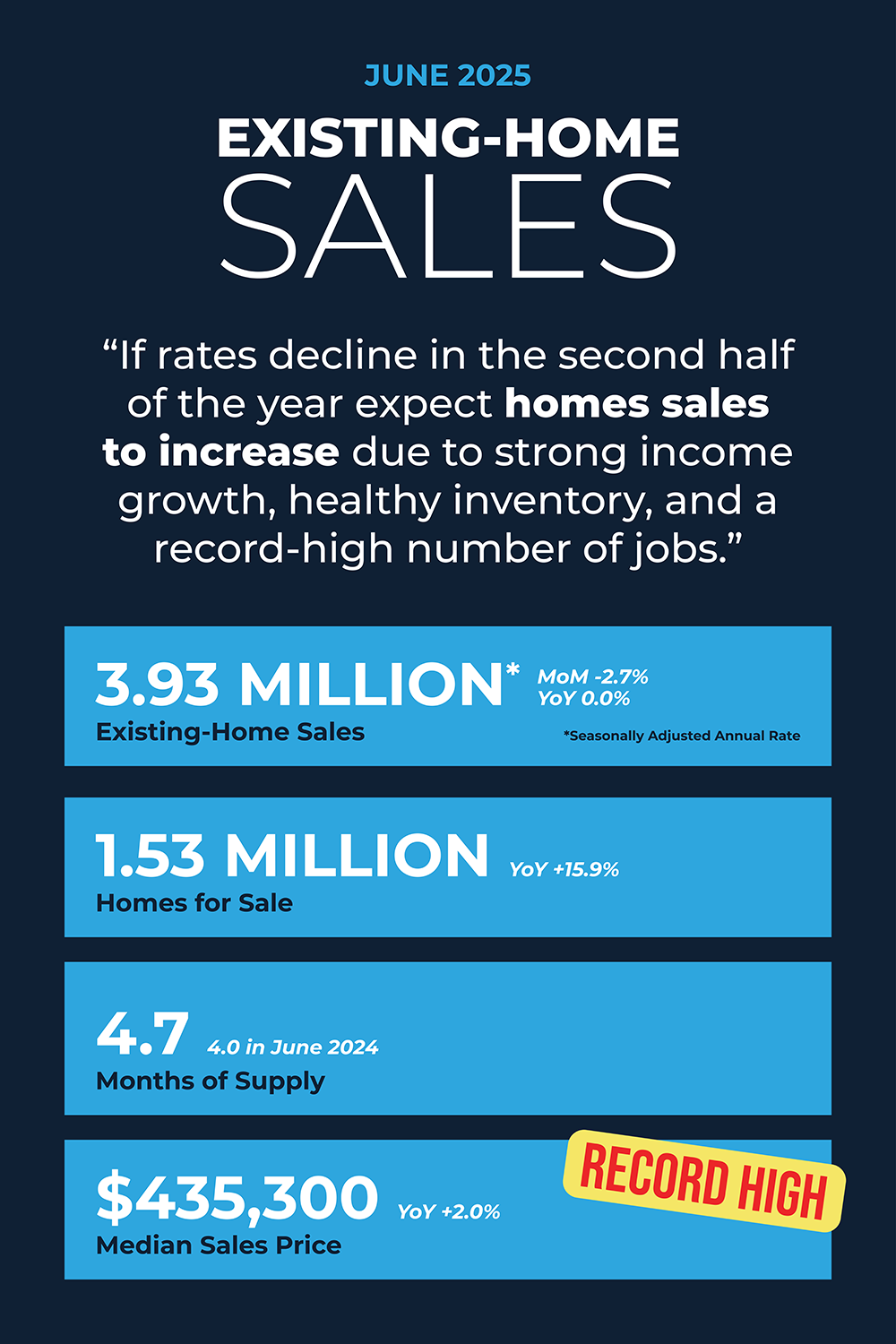
Existing-home sales decreased by 2.7% in June, according to the National Association of REALTORS® Existing-Home Sales Report. The Report provides the real estate ecosystem, including agents and homebuyers and sellers, with data on the level of home sales, price, and inventory.
Month-over-month sales declined in the Northeast, Midwest and South and rose modestly in the West. Year-over-year, sales fell in the Northeast and West, while rising in the Midwest and South.
"The record high median home price highlights how American homeowners' wealth continues to grow—a benefit of homeownership. The average homeowner's wealth has expanded by $140,900 over the past five years," said NAR Chief Economist Lawrence Yun.
"Multiple years of undersupply are driving the record high home price. Home construction continues to lag population growth. This is holding back first-time home buyers from entering the market. More supply is needed to increase the share of first-time homebuyers in the coming years even though some markets appear to have a temporary oversupply at the moment."
Total Existing-Home Sales for June
-
2.7% decrease in total existing-home sales month-over-month to a seasonally adjusted annual rate of 3.93 million.
-
No change in sales year-over-year.
Inventory in June
-
1.53 million units: Total housing inventory, down 0.6% from May and increased 15.9% from June 2024 (1.32 million).
-
4.7-month supply of unsold inventory, up from 4.6 months in May and 4 months in June 2024.
Median Sales Price in June
- $435,300: Median existing-home price for all housing types, up 2% from one year ago ($426,900) — a record high for the month of June, and the 24th consecutive month of year-over-year price increases.
Regional Breakdown
Northeast
- 8% decrease in sales month-over month to an annual rate of 460,000, down 4.2% year-over-year.
- $543,300: Median price, up 4.2% from June 2024.
Midwest
- 4% decrease in sales month-over month to an annual rate of 950,000, up 2.2% year-over-year.
- $337,600: Median price, up 3.4% from June 2024.
South
- 2.2% decrease in sales month-over month to an annual rate of 1.81 million, up 1.7% year-over-year.
- $374,500: Median price, up 0.3% from June 2024.
West
- 1.4% increase in sales month-over month with an annual rate of 710,000, down 4.1% year-over-year.
- $636,100: Median price, up 1% from June 2024.
 Before making an offer on a home in today's competitive housing market, it is more important than ever for home buyers get their financial house in order when applying for a loan.
  Sellers, you have an excellent opportunity to sell your home this season if you have the right pricing strategy in place from the start! Studies show that the longer a property stays on the market, the less the seller will net upon the sale. It is very important to price your property at a competitive market value at the signing of your listing contract. The market today in many places is so competitive that even over-pricing by a few thousand dollars could mean that your house will not sell as soon as it could.